

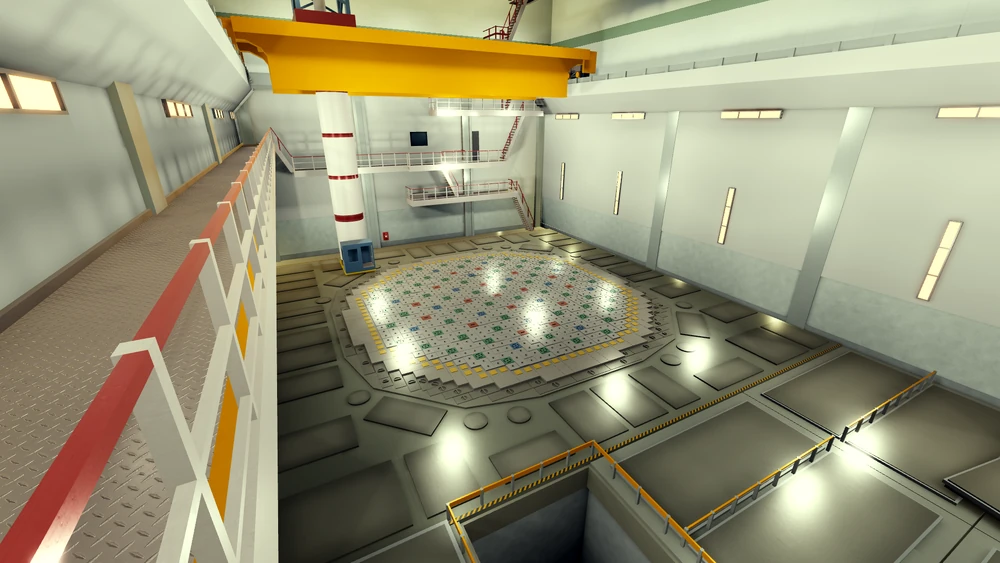
What is the RBMK-1500?
The RBMK-1500 (Russian: Reaktor Bolshoy Moshchnosti Kanalnyy, meaning "High Power Channel-type Reactor") is a Soviet-designed nuclear reactor used mainly in power plants for electricity generation. The number 1500 refers to its electrical output of 1,500 megawatts (MW), making it one of the most powerful variants in the RBMK series.
Design and Operation
The RBMK-1500 is a thermal neutron reactor, meaning it uses slow (thermal) neutrons to sustain the nuclear chain reaction. It is moderated by graphite, which slows down neutrons, and cooled by light (ordinary) water circulating through pressure tubes. Unlike most reactors, the RBMK’s core is made up of many individual vertical pressure tubes, each containing fuel rods, which allows the reactor to be refueled while still in operation — a significant operational advantage.
Key Characteristics:
• Moderator: Graphite blocks, surrounding the fuel channels, slow down neutrons to maintain the chain reaction.
• Coolant: Light water circulates inside the pressure tubes, removing heat from the fuel rods to produce steam.
• Fuel: Low-enriched uranium dioxide (UO₂) pellets stacked inside zirconium alloy cladding rods.
• Power output: Electrical output of around 1,500 MW, with thermal power roughly 4,800 MW.
• Design type: Channel-type reactor, with a large graphite moderator block and many pressure tubes.
• Safety systems: Multiple control rods for neutron absorption, emergency shutdown systems, and various cooling mechanisms.
Historical and Operational Context
The RBMK design was developed in the Soviet Union during the 1960s and 1970s to fulfill the demand for large-capacity nuclear power plants using indigenous technology and abundant graphite moderation. The RBMK-1500 was one of the largest reactors of its kind, intended for high output at plants like the Ignalina Nuclear Power Plant in Lithuania.
While the RBMK design offered operational flexibility and high power output, it also had design flaws, including a positive void coefficient (meaning the reactor can become more reactive if steam bubbles form in the coolant), which contributed to the Chernobyl disaster in 1986 (though the RBMK-1500 was not directly involved, the design principles are similar).